Greece Beaches 2026 Without Sunbeds: 198 Protected Beaches, the MyCoast App and Fines up to €220,000
In March 2026 Greece passed its strictest beach reform in two decades: 70 % of every beach must be sunbed-free, 198 beaches are now fully protected, drones patrol the coast and the MyCoast app turns every tourist into an inspector. Fines reach €220,000. Here is what it means for your towel in Vourvourou, Sarti and Posidi.
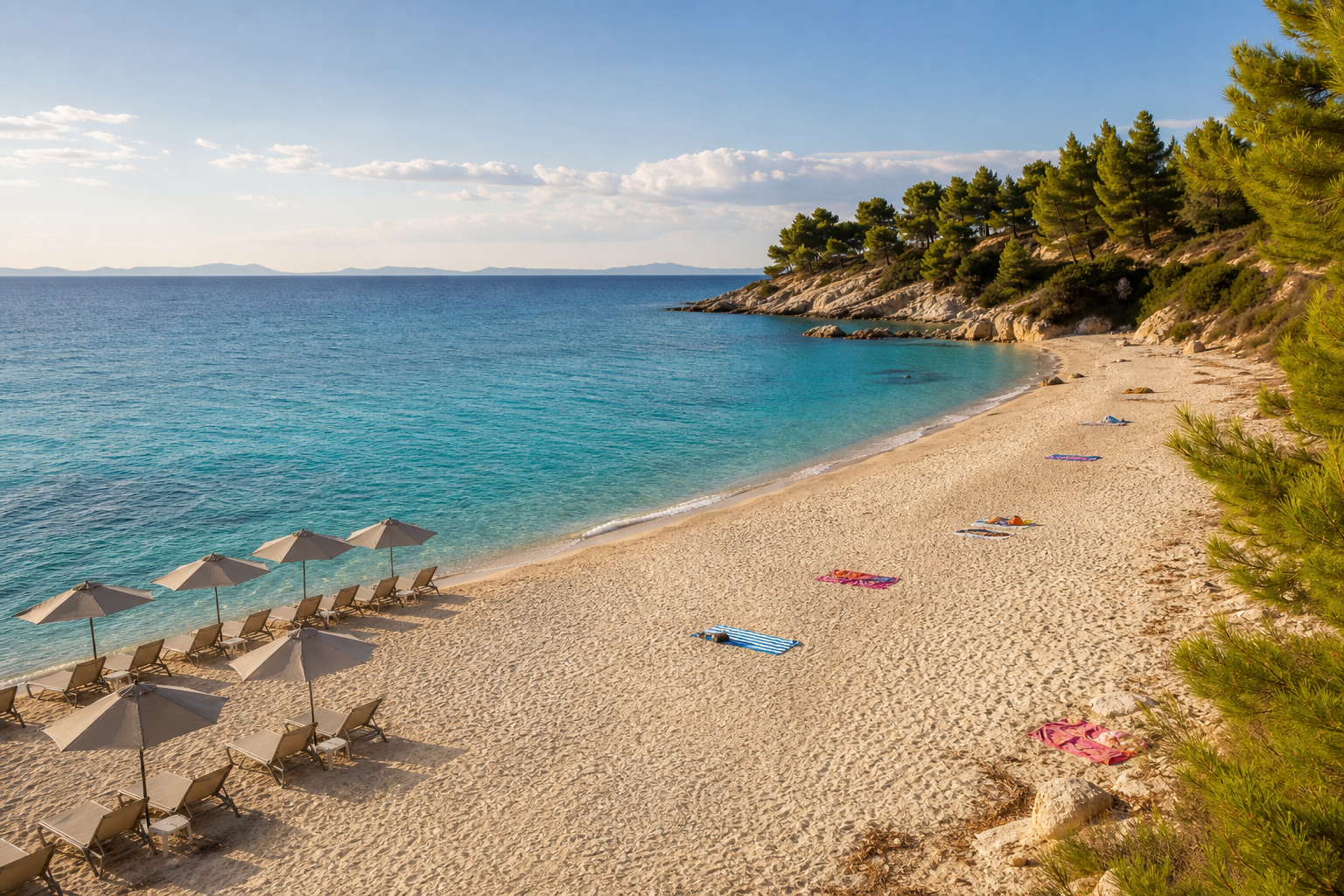
If your last summer was spent squeezing your towel between three rows of sunbeds and a wet beach-bar umbrella - summer 2026 brings a small shock. In March, Greece passed its most radical beach reform in two decades: at least 70 % of every beach must stay free for your towel, 198 beaches have received full-protection status (no sunbeds at all), and enforcement is now done with drones and the MyCoast mobile app that any tourist can open. The first record fine of the season was €220,000. Here is everything you need to know before you bring a towel to Vourvourou, Sarti or Posidi.
The new 70/30 rule - what it actually means
The law that came into force in March 2026 is crystal clear:
- At least 70 % of a commercial beach must stay completely free - no sunbeds, umbrellas or any commercial beach furniture.
- In protected zones (Natura 2000) the threshold is even stricter - 85 %.
- The first row of sunbeds must be at least 4 m back from the sea - meaning the front row no longer dips its feet in the water.
- Sunbeds and umbrellas must be arranged in a clearly delimited zone that is geographically defined in the rental contract and entered into a public register.
💡 Practical translation: if you arrive at a commercial beach and the sunbeds cover more than a third of the sand - the bar is operating illegally. You have the right to file a report and to spread your towel anywhere in the free zone, for free.
198 fully protected beaches - no sunbeds anywhere
Beyond the 70/30 rule, the Greek government has published a list of 198 beaches where any form of commercial activity is banned - not a single sunbed, umbrella or beach equipment may be placed. The reason: ecological sensitivity (Caretta caretta sea-turtle nesting sites, dunes, freshwater springs, rare plant species).
Most popular protected beaches that travellers from the Balkans visit
| Region | Beaches under full protection | What to bring |
|---|---|---|
| Sithonia (Halkidiki) | Vourvourou - Karidi and Diaporos coves, part of Sarti (north cape), Kavourotripes („Orange Beach") | Towel, your own „pickado" umbrella, cooler |
| Kassandra (Halkidiki) | Cape Posidi (west and east arm), part of the beach below Afitos | Towel + water, no beach bar on the sand |
| Lefkada | The entire west coast - Egremni, Porto Katsiki, Milos | Towel, snorkelling gear, food |
| Thassos | Saliara („Marble Beach"), Livadi, part of Paradise Beach | Water-shoes (marble pebbles burn hot) |
| Olympic Riviera | Litochoro cove and Plaka Litochoro (parts inside Natura 2000) | Towel, sunscreen, water |
⚠️ The list keeps expanding through the season - the official register is published by the Hellenic Public Properties Company. Check before you travel whether your beach has the status.
MyCoast - the app that turns tourists into inspectors
To actually enforce the 70/30 rule, Greece has rolled out the free MyCoast app (available on iOS and Android, in English and Greek). The logic is simple: the app opens a map of the beach, shows exactly what surface a beach bar is allowed to occupy, and if anything is over the line you file a report in two taps.
How to use MyCoast in practice
- Download the app (search „MyCoast" on the App Store / Google Play).
- Allow location when you arrive at the beach - the app auto-detects the cove.
- The map shows two zones: yellow = legal bar zone, blue = free zone for your towel.
- If you see a sunbed standing in the blue zone, tap „Report violation", snap a photo, the app sends GPS + image straight to the tourist police.
- Inspection typically arrives within 24–48 h. Your report stays anonymous.
Drones and satellite imagery
Alongside user reports, the Greek government operates a fleet of commercial drones that fly the coastline and compare imagery with satellite maps. An algorithm flags deviations from the rental contract and inspectors show up without anyone having to call. This is especially active on remote beaches where there are few tourists.
Fines - how much it actually hurts
| Violation | Fine |
|---|---|
| Exceeding the allowed zone (up to 20 %) | €2,000 - €5,000 |
| Exceeding by more than 20 % or operating without a permit | €10,000 - €60,000 |
| Sunbeds inside a full-protection zone (Natura 2000) | up to €220,000 + licence revoked |
| Repeat offence | permanent licence revocation |
The first record fine of €220,000 was issued already in April 2026 to a business operating without a permit on Timari beach in Anavyssos (Attica). The message from Athens is clear: no more warning regime - enforcement is immediate, and very expensive.
What this practically means for your 2026 holiday
- Paid sunbeds and umbrellas remain, but in a smaller zone. Prices will probably rise - fewer slots, same demand. Expect €10–€25 a day for two sunbeds + umbrella on popular Halkidiki beaches.
- Free spots fill up earlier. If you want shade in Pefkohori or Hanioti, arrive by 9 a.m.
- Bringing your own „pickado" umbrella is now normal. Most Greeks and locals already do it - join in. The free zone is yours.
- On protected beaches there is no bar - bring everything yourself. Water, food, shade. Best to leave the hotel early and turn the day into a full excursion.
- MyCoast is there for you too. If anyone tries to push you off „their" sand beyond the 4 m line - report. The sand is public.
FAQ - the most common questions
Can I bring my own umbrella and sunbed?
Yes, of course. In the free zone (70 %, or 85 % on protected beaches) you have the right to set up your own „pickado" umbrella and mat for free. Nobody can charge you for the sand.
What if a beach bar asks me to pay an „access" fee to the beach?
Illegal. In Greece all beaches are public property. If anyone tries to extort you, record the conversation, report through the MyCoast app or call the tourist police (171 - 24/7 in English).
Are the main Halkidiki beaches still open for a standard holiday?
Yes. All main beaches - Pefkohori, Hanioti, Polychrono, Kallithea, Nikiti - still operate with sunbeds, just in smaller zones. A small share of wilder coves (Karidi, part of Vourvourou, Kavourotripes) moves to full protection.
Is MyCoast mandatory?
No. Nobody forces you to install it. It is a voluntary civic tool. But if you ever get into a dispute with a beach bar over space - it helps a lot to have it on your phone.
Conclusion
Greece in 2026 hasn't banned sunbeds - it has brought back the towel. For anyone who arrives at the beach early and carries their own umbrella, these are excellent news: more free sand, less crowding around sunbeds, controlled bars. For those who like „all-inclusive" sand with iced drinks - it will be a bit more expensive and a bit further from the water. Either way, the rules are clear, the fines are real, and the MyCoast app gives every tourist a voice. The sand is public again.
For all other news of the season - the new fee schedule, cruise levy and other regulations - see our detailed 2026 guide. If you are driving down, also check the latest on the Tempi detour and the E75 closure near Larissa.