Kids travel first aid kit - what to pack for Greece in 2026
A complete guide: fever, diarrhoea, insect bites, sunburn, ear and eye drops, motion sickness. What to bring, what you can buy at a Greek pharmacy, what you CAN NOT get without a prescription, plus emergency numbers.
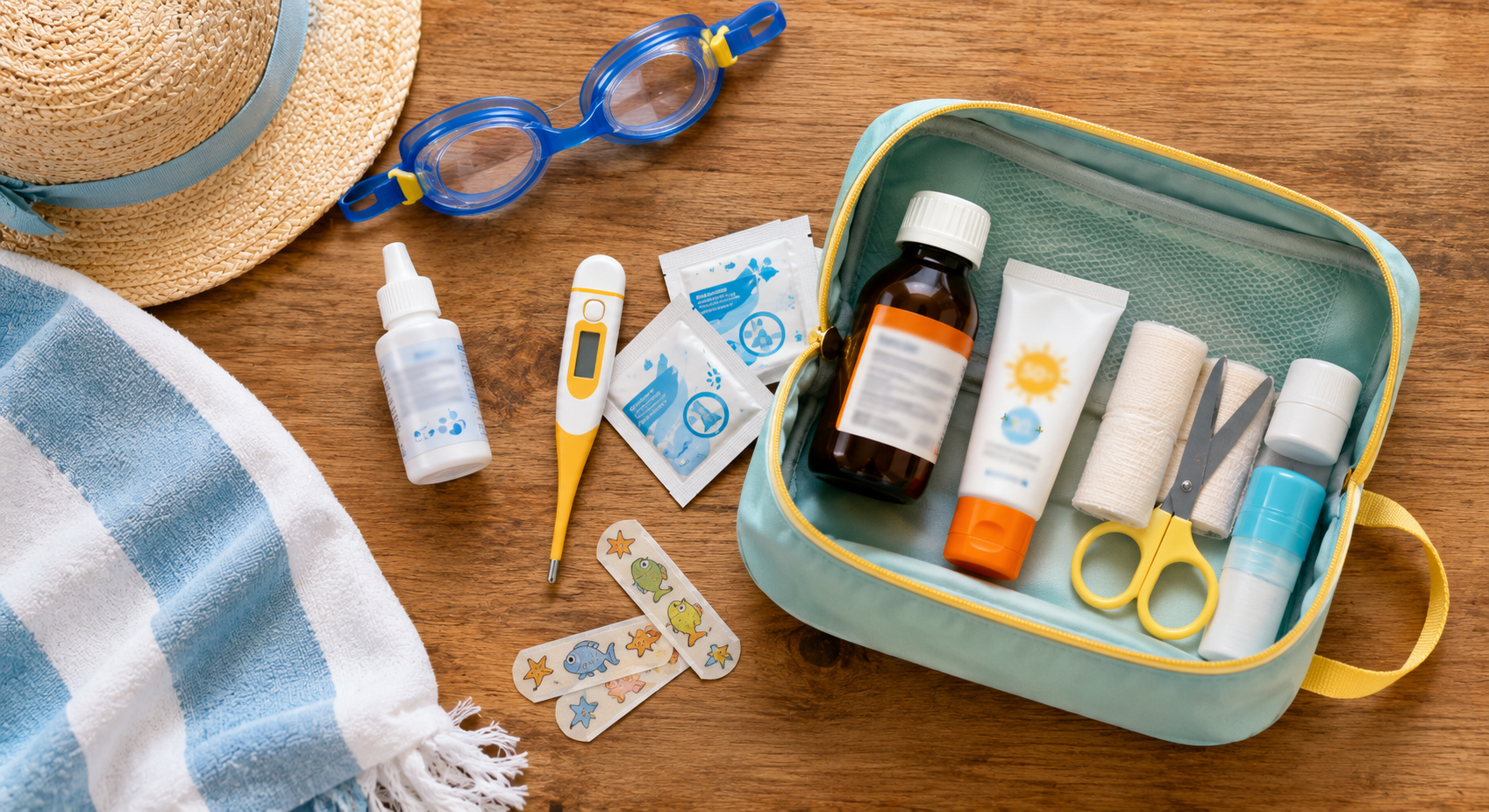
The scene no parent wants: three days into the holiday, your child spikes a 39°C fever at 11 pm, the pharmacy is shut, you don't know where the nearest hospital is, and your phone is hunting for a signal. A kids first aid kit isn't a luxury - it's the basic safety net - and it is much cheaper than a midnight drive to Thessaloniki. This is our complete 2026 packing list, drawn from Serbian paediatricians and Greek pharmacists.
⚠️ Important note: this guide is not a substitute for your paediatrician. If your child has a chronic condition, allergies or is on regular medication, always consult the doctor before travel and pack your health booklet, a copy of the EHIC card and a list of every medication the child takes.
The golden rule - prep everything in advance, do not rely on a foreign pharmacy
Greek pharmacies (φαρμακείο, "farmakio") are excellent - wider selection than Serbian ones, often well-trained staff. But there are three problems while you are on holiday:
- Opening hours. Most pharmacies open 8 am to 2 pm, break, then 5–9 pm. On weekends and holidays only the rota pharmacy is open - possibly 15 km from your hotel.
- Language barrier. Active ingredient names are universal (paracetamol, ibuprofen), but with a sick child the stress complicates things.
- Price. Medicines that cost 200 RSD in Serbia can run €5–10 in Greece. Children's ibuprofen syrup - €8–12 in Greece, ~€3 in Serbia.
So - pack everything you regularly use and leave the Greek pharmacy for genuine emergencies.
1. Fever, pain, cold - the essentials
| What to pack | Why and how |
|---|---|
| Paracetamol syrup (Calpol, Panadol Baby, Efferalgan) | First line for fever in babies 3 months+ |
| Ibuprofen syrup (Nurofen for Children, Brufen) | Stack with paracetamol for stubborn fever, from 6 months |
| Paracetamol suppositories | A lifesaver when the child is vomiting and can't keep syrup down |
| Digital thermometer | Don't rely on a hand to the forehead. Contactless is ideal on the move. |
| Throat spray / lozenges for older kids | A/C plus ice cream = sore throat in 30% of cases |
💡 Dosage: always by body weight, not by age. Standard: paracetamol 10–15 mg/kg every 4–6 hours (max 4 doses/day), ibuprofen 5–10 mg/kg every 6–8 hours. When in doubt - read the leaflet or ask the pharmacist before you leave.
2. Stomach trouble and diarrhoea - the most common issue
A change of water, different food, climate change and - most often - too much ice cream, lead to stomach problems in 1 in 3 children on holiday. Be ready:
- Oral rehydration salts (ORS) - Humana Elektrolit, Dioralyte, Pedialyte. The single most important item for diarrhoea/vomiting. Give a teaspoon every 5–10 minutes.
- Probiotic (BioGaia, Linex, Optibac for Children). Start 3 days before travel and continue throughout as prevention.
- Loperamide (Imodium) - only for children over 6 years and as directed by a doctor. Don't stop diarrhoea in young children without medical advice.
- Smecta or similar adsorbent - helps mild diarrhoea, safe from age 2.
- Domperidone (Motilium) - for nausea and vomiting, prescription-only, but worth having if your child vomits often.
⚠️ When to see a doctor urgently: blood in stool, vomiting lasting more than 6 hours, high fever with diarrhoea, a listless child with dry lips (dehydration). Don't wait.
3. Sunburn and sun safety - the biggest beach lesson
The modern world knows a lot about the sun - yet sunburn in children remains the top reason holidaying families end up at the doctor. The Aegean sun in July/August hits UV index 9–11 (extreme).
| Product | Role |
|---|---|
| SPF 50+ sunscreen for kids | Mineral base (zinc oxide) for under-3s. Reapply every 2 hours and after every swim. |
| After-sun lotion with aloe vera | Soothes skin after every sun day, prevents peeling. |
| Panthenol cream or spray (Bepanthen) | For mild burns - soothes, cools, speeds healing. |
| Hydrocortisone 1% cream | For stronger burns and local allergic reactions. Max 7 days in a row. |
| Wide-brim hat + UV-rated swim shirt | Best protection = not being out from 11 am to 4 pm. Full stop. |
4. Insect bites, allergies and rashes
Summer in Greece means mosquitoes, sand flies, bees around tavernas and jellyfish in some shallow bays. Plus new swimwear materials, different laundry detergents at the accommodation - allergies can surprise you.
- Kids' insect repellent with max 10–30% DEET (from age 2) or picaridin (safer for younger kids). Fragrance-free.
- Bite-relief gel (Fenistil gel, Calamine lotion) - soothes itching, prevents scratching.
- Children's antihistamine (Aerius/desloratadine syrup, Zyrtec) - for allergic reactions and severe itching.
- EpiPen if your child has a known allergy to bee stings or food - never travel without it.
- Vinegar - buy locally: the standard Greek first aid for a jellyfish sting. Every seaside kiosk sells it.
5. Cuts, scrapes and wounds
Children, the beach, rocks, pebbles, a grazed knee from the funfair scooter. A small first aid kit is essential:
- Sterile gauze + plasters in different sizes (waterproof!)
- Antiseptic - Octenisept or Betadine (iodine) for wounds
- Haemostatic gauze or compression bandage for heavier bleeding
- Small round-tipped scissors and tweezers (for splinters)
- Thermal water spray - pH-neutral, washes sand and salt out of cuts
- Healing balm (Bepanthen) - for both small wounds and nappy rash on babies
6. Motion sickness and air travel
The hilly drive through Kassandra or the road to Hanioti - some children are magnets for nausea. Plus turbulence if you fly.
- Children's Dramamine (from age 2) - give 30–60 min before travel.
- Sea-Band wristbands - acupressure on the inner wrist. Drug-free, works for mild nausea.
- Ginger sweets or tea - natural alternative, kids usually like the taste.
- Sick bags - banal but a lifesaver in the car.
7. Nose, eye and ear drops
- Saline solution (Sterimar, Vibrocil) for nasal washing - A/C and sand cause blocked noses.
- Decongestant nasal drops (Olynth Baby/Junior) - only for severe blockage, max 3 consecutive days.
- Ear drops (Otipax, if prescribed) - earache from swimming water is common.
- Artificial tears (Hylo-Comod, Optive) - for eyes irritated by salt, chlorine and sand.
How Greek pharmacies (farmakeio) work
If, despite preparation, you do have to visit a pharmacy - practical info:
| Item | Detail |
|---|---|
| Opening hours | Mon/Wed/Sat: 8:00–14:30. Tue/Thu/Fri: 8:00–14:30 and 17:30–21:00. Sunday: rota only. |
| How to spot one | A green cross (often neon, flashing). The word ΦΑΡΜΑΚΕΙΟ on the sign. |
| On-call rota | The list is posted on every pharmacy door (rotates daily). Ask reception or search "farmakeia efimereuonta + town name". |
| Payment | Cash or card. EHIC covers emergencies, but most OTC drugs are full price. |
| English | Most pharmacists in tourist areas speak decent English. In smaller villages - less so. |
What you CAN'T buy without a prescription
Greece is strict on prescriptions, particularly after 2020:
- Antibiotics - absolutely no over-the-counter sale. A pharmacist who sells antibiotics without a Greek prescription risks losing their licence. Don't ask, they won't sell.
- Stronger painkillers with codeine - prescription-only.
- Asthma medication, corticosteroids, insulin - prescription required.
- EpiPen - available in Greece, but only with a prescription (get it in advance from your paediatrician if the child has allergies).
💡 Pro tip: if your child is on chronic medication, bring an English-language copy of the prescription showing the active ingredient (not just the brand name). Most paediatricians will write one if you ask.
Greece emergency numbers
EHIC card - sort it before you travel
The European Health Insurance Card (EHIC) covers EU citizens - and Serbian citizens with valid public health insurance via the bilateral convention. It is free from your local health fund a few days before travel. With it:
- State doctor visit - free or symbolic (€5–10)
- State hospital emergency admission - covered
- On-call pharmacy emergency packs - at local insured rates
⚠️ EHIC does not cover private clinics, medical repatriation flights, or planned procedures. For real protection, travel health insurance with up to €30,000 coverage is essential - costs €15–25 for a family of four for 10 days.
Packing checklist - print and tick
☐ Ibuprofen syrup
☐ Digital thermometer
☐ ORS (Dioralyte / Humana Elektrolit)
☐ Probiotic (BioGaia / Optibac)
☐ Smecta or adsorbent
☐ SPF 50+ kids sunscreen
☐ After-sun + Bepanthen
☐ Hydrocortisone 1% cream
☐ Insect repellent with picaridin/DEET
☐ Fenistil gel or Calamine
☐ Antihistamine syrup (Aerius/Zyrtec)
☐ Sterile gauze + waterproof plasters
☐ Octenisept antiseptic
☐ Tweezers + small scissors
☐ Children's Dramamine (if driving)
☐ Saline nasal solution
☐ Olynth Baby drops
☐ Hylo-Comod artificial tears
☐ Health booklet + EHIC card
☐ Travel health insurance policy
☐ English-language list of chronic medication
☐ Numbers: 112, 166, hotel reception
Final word - better safe than sorry
A kids first aid kit fits in a small wash bag, costs €30–50 to assemble in total, and can be the difference between a calm afternoon and a hospital night. Pack it all in advance, while you're still at home - prices are lower, prescriptions easy, and you have time to consult your paediatrician if anything is unclear.
The Aegean and a worry-free holiday are ahead of you. With the right list in your suitcase - both become a near-certainty. Safe travels.