Greece 2026: new taxes, regulations and what they mean for your wallet
Climate Resilience Fee per night, a new 20 EUR cruise levy on Santorini and Mykonos, anti-overtourism rules, ferry strikes. We break down every new cost of holidaying in Greece in 2026 - with real-world family math.
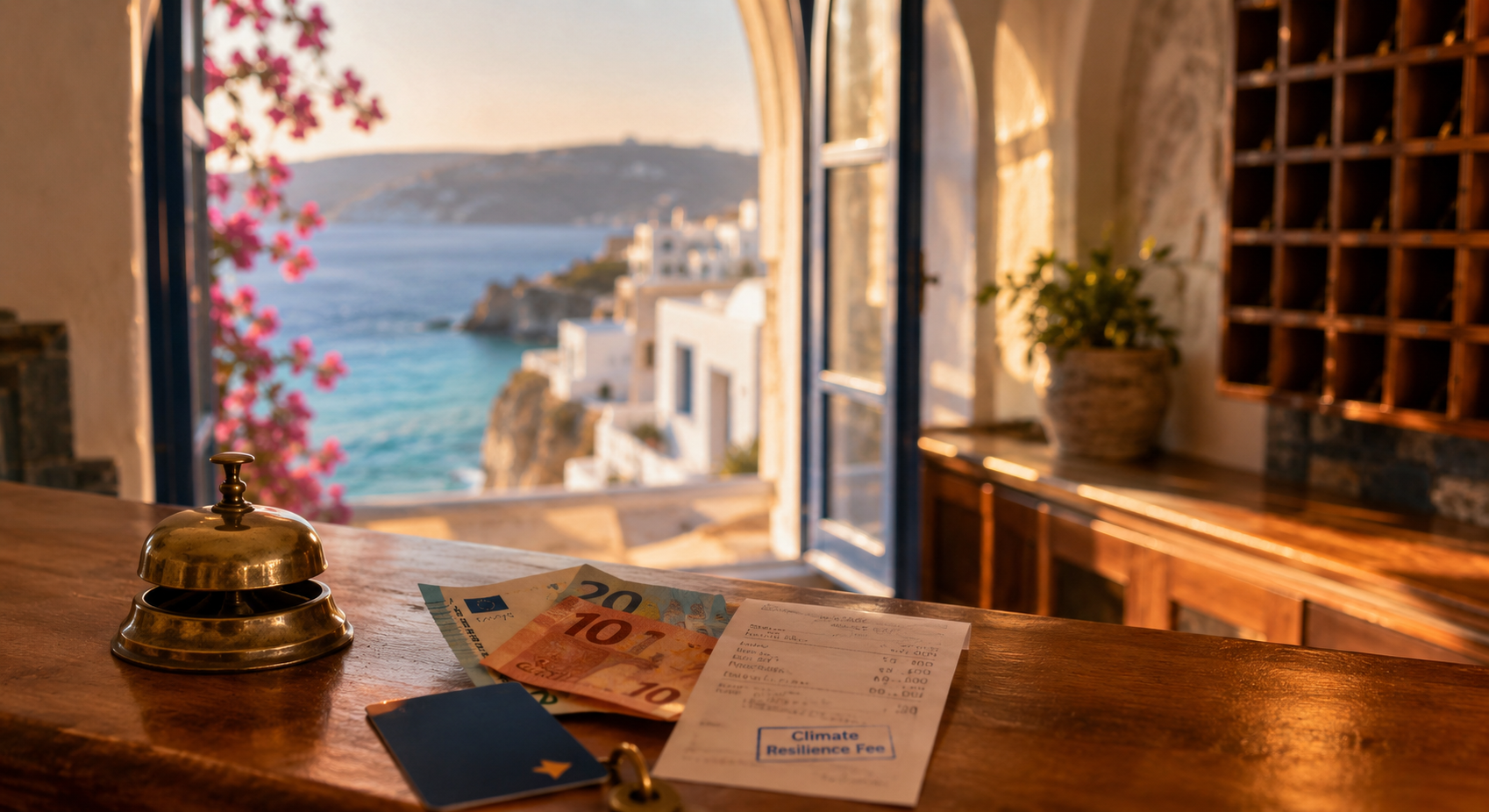
Holidaying in Greece in 2026 won't be quite like last year. The government has introduced a fresh package of taxes, regulations and restrictions - some are quiet line items you pay directly at reception, others are part of a national push against overtourism. This guide breaks down every new cost, the actual amounts per accommodation tier, and what it really means for an average family heading to Halkidiki or Thassos.
Climate Resilience Fee - the tax you won't see in your booking
Officially the Climate Crisis Resilience Fee (CCRF), casually called the "climate tax". Introduced in 2024 as a response to devastating wildfires and floods, with rates substantially increased from January 2026. The crucial point: it is not paid through booking platforms and not included in any package price. The property owner or hotel reception collects it on the spot - cash or card - at check-in or check-out.
Rates by accommodation tier (high season, April–October 2026)
| Accommodation category | High season | Low season |
|---|---|---|
| 1★ and 2★ hotels, camping, lower-tier apartments | €2/night | €0.50/night |
| 3★ hotels and apartments | €5/night | €1.50/night |
| 4★ hotels | €10/night | €3/night |
| 5★ hotels and luxury villas | €15/night | €4/night |
💡 Key rule: the fee is charged per room, not per person. A family of four in one room pays the same as a single traveller. For a 10-night stay in a 3★ hotel on Kassandra, that's €50 extra; at a 4★ resort on Crete - €100.
New cruise levy - Santorini and Mykonos in the crosshairs
This is the biggest novelty for the 2026 season. If you arrive at Santorini or Mykonos by cruise ship, you pay an additional disembarkation fee - per person (not per room as with the CCRF). The reasoning is simple: up to 17,000 cruise passengers a day on an island with 15,000 residents had become unsustainable, and Greece wants to redirect pressure to smaller islands.
Seasonal cruise rates
| Period | Santorini & Mykonos | Smaller islands |
|---|---|---|
| June 1 - September 30 | €20 | €5 |
| April, May, October | €12 | €3 |
| November - March | €4 | €1 |
Does this apply if you arrive by ferry or plane?
No. The cruise levy applies only to large cruise-ship passengers - those spending only a few hours in port. Ferry arrivals from Piraeus, flights into an island airport, or driving overland to Halkidiki - none trigger the levy. You only pay the standard CCRF at your hotel.
Real example: family of four, 10 nights in Halkidiki
Theory aside - here's the typical 2026 scenario, two adults and two children, 4★ hotel in Pefkohori, 10 nights:
| Item | Cost |
|---|---|
| Accommodation (4★ family room, 10 nights) | ~€1,400 |
| Climate Resilience Fee (€10 × 10 nights, paid at reception) | €100 |
| Car + tolls + fuel Belgrade–Halkidiki–Belgrade | ~€250 |
| Food, tavernas, day trips | ~€600–800 |
| Total (all in) | ~€2,350–2,550 |
The real cost of just the accommodation is therefore not €1,400 but €1,500. The CCRF is a small line item in the wider picture - but if €10 a night surprises you at reception after a long drive, know it's a statutory tax, not a hidden charge.
Special Spatial Framework - anti-overtourism rules
In February 2026 Greece published its Special Spatial Framework for Tourism - the first national strategy concretely regulating tourism growth by region. The practical implications:
- Restrictions on new tourist beds in saturated zones: Santorini, Mykonos, Rhodes, Corfu, Zakynthos. Fewer new hotels = higher prices on existing ones.
- Tighter oversight of Airbnb and other short-term rentals, with new taxes in the most popular destinations. Average Airbnb prices on Santorini are expected to rise 10–15% in 2026.
- Investment redirected to less-developed regions - Kassandra, Thassos, Sithonia and mainland Halkidiki remain stable and open to new capacity. Good news for travellers who don't chase the Cycladic photo-op.
- Smaller islands receive state promotion as alternatives to Santorini and Mykonos - Skopelos, Andros, Alonissos, Kalymnos, Astypalea. (We cover them in detail in our companion article.)
Ferry strikes - how to avoid getting stranded
On May 1, 2026 the Panhellenic Seamen's Federation (PNO) held a 24-hour strike - every ferry in every category was docked from midnight to midnight. Strike season typically runs May to September, mostly one-day actions, but they can surprise.
⚠️ Strikes affect only ferries. Domestic Aegean Airlines and Sky Express flights to Crete, Rhodes, Corfu and Santorini run as normal. If you need a same-day island arrival, flying is the safer option in strike season.
What to do if you're island-hopping
- Check the PNO website and Greek news 2–3 days before travel - strikes are usually announced a week in advance.
- Build in a one-day buffer - an extra night in Thessaloniki or Athens is cheap insurance if your ferry doesn't sail.
- Mainland Greece (Halkidiki, Olympic Riviera, Parga) - ferry strikes don't affect you here.
Practical pre-trip checklist
The verdict - is Greece still worth it?
Yes, but not the way it was in 2022. Greece is simply adjusting prices to cover real climate-crisis and overtourism costs. The key is knowing what to expect at reception. For a standard Halkidiki or Thassos holiday, the surcharge is under €100 per family for 10 nights - almost painless. For premium destinations like Santorini, especially via cruise, the math is very different.
Our take for 2026: stick with the classics (Halkidiki, Thassos, Olympic Riviera) or experiment with the "hidden gems" from the Special Spatial Framework list - where Greece actively channels tourists, and you still get the same Aegean Sea and the same food.